

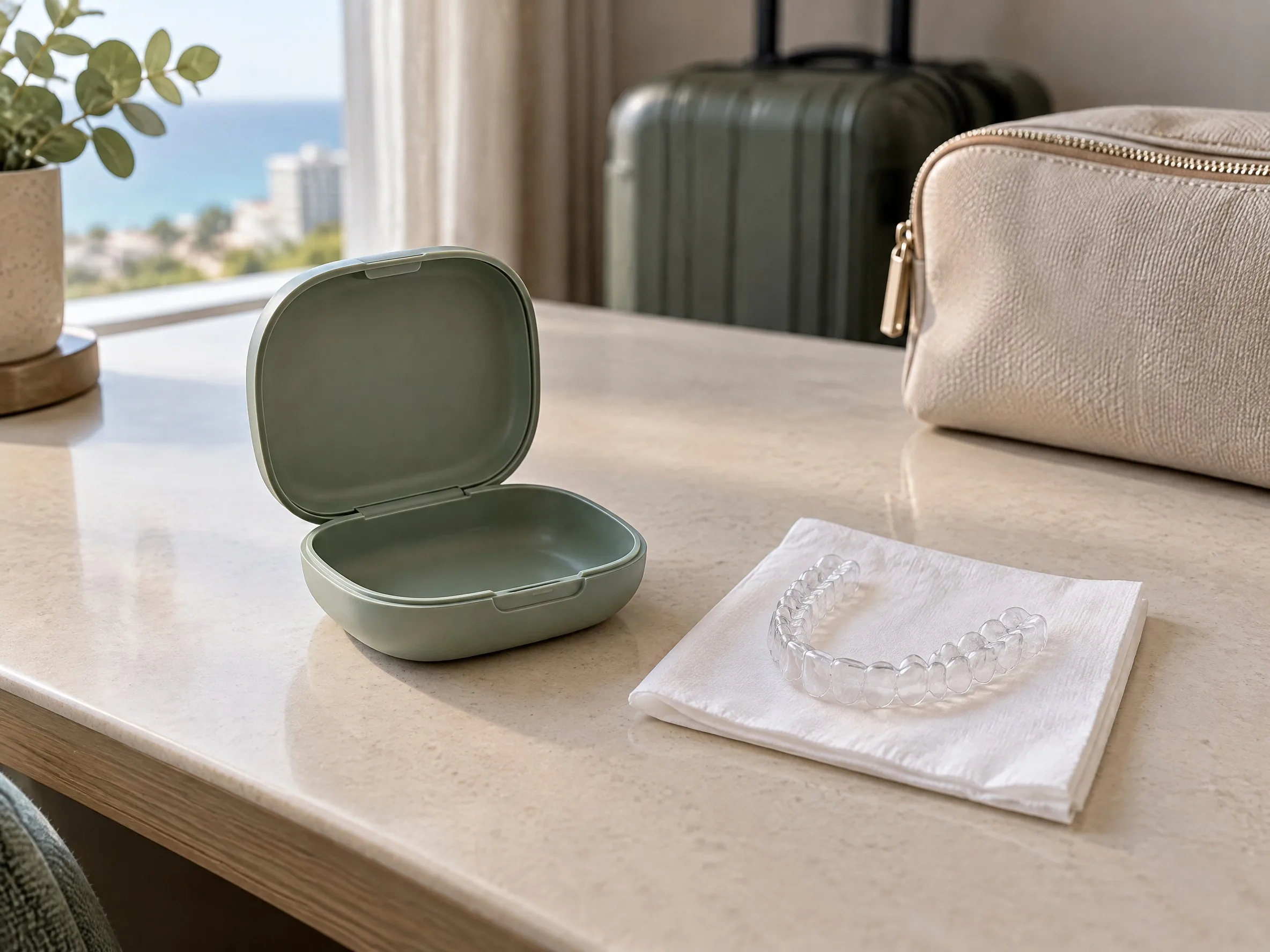
You open the case and one tray is missing. You're away from home, the next set is in your bag, and you want to know whether you can simply put that one in.
Contact your treating dental team promptly rather than choosing a replacement tray from online advice. The Australian Society of Orthodontists advises an early appointment for a lost or poorly fitting aligner. Tweed Family Dental lists both Invisalign and TrioClear, so tell the team which system you use. [1] [2]
What should I do first if my aligner is lost?
Contact the team supervising your treatment and explain exactly what is missing. Orthodontics Australia's guidance, published by the Australian Society of Orthodontists on 1 September 2021, specifically includes a lost or poorly fitting clear aligner as a reason to arrange an appointment as early as possible. It does not provide a one-size-fits-all tray-switch instruction. [1]
You don't need a polished explanation before you call. A simple description is enough to start: the upper tray, the lower tray, both current trays, or a future set you packed for later. Those are different situations to describe, even if they all feel like "I've lost my aligners".
- Write down which tray or set is missing and when you last had it.
- Find the packaging, tray number and any written instructions you were given. If you don't have them, say so.
- Contact your treating team and ask what to do now, which appliance to use if any, and whether an appointment is needed.
- Write down the reply, including which tray it refers to and when you should next contact the team.
These steps help you organise the conversation; they don't replace an assessment. If another practice is managing your treatment, start with that practice rather than assuming Tweed has your treatment plan. If you're a Tweed patient, our clear aligner information identifies the systems offered here. Your own instructions still matter. [2]
Should I use the previous tray or skip to the next one?
Ask your treating clinician for an instruction specific to your plan; this article cannot choose a tray for you. Tweed's published advice is to follow your dentist's instructions, and the Australian Society of Orthodontists recommends early assessment when an aligner is lost or does not fit well. Neither source supplies a universal rule based on how many holiday days you have left. [2] [1]
It can be confusing to find one website recommending the previous tray and another suggesting the next. Those suggestions may be written for a different patient or system. The useful question for your team is: "I have these trays with me. Which, if any, should I use, and for how long?" Avoid treating a general web page as your personal change schedule.
Be precise if only one tray is missing. Ask about the upper and lower trays separately rather than assuming the answer applies to both. If you still have the current set but have misplaced a future set, make that distinction at the start of the conversation. You can also ask the team to repeat the tray number so you can check it against the packaging.
If you use Invisalign, the clinic's Invisalign service page is a relevant starting point for background information. It isn't an emergency replacement prescription. The same caution applies to reading advice intended for another clear aligner brand.
What can I arrange while I'm away from Tweed Heads?
Tell your treating team where you are and when you expect to return, then ask what care they recommend. The Australian Society of Orthodontists' advice is to arrange an appointment early for a lost aligner, not to postpone contact until your trip ends. [1]
You might be on a short break, travelling for work or visiting family for several weeks. Instead of trying to calculate a waiting period yourself, give the team the practical details. Can you receive a call? Will you be somewhere else tomorrow? Is there a local dentist you can attend if advised? These are questions about arranging care, not reasons to change trays without an instruction.
| Your situation | What to tell or ask the treating team |
|---|---|
| The current tray is missing | Which jaw, tray number if known, and when you last wore it. Ask what to use now. |
| A future set is missing | Which set you still have and which set you cannot find. Ask for a specific change instruction. |
| You're away for longer | Your location and return date. Ask whether you need local assessment and how records can be shared. |
| You don't know the tray number | Say that clearly. Ask which details or photographs the team needs and how to send them. |
| You're worried about cost | Ask whether a replacement is needed, what it would cost and what your existing agreement includes. |
Don't make travel or delivery plans around an assumed replacement date. Ask your practice whether a replacement is needed, whether there is a fee, and when it could be available. Get those details confirmed rather than relying on a fee or delivery estimate from another clinic's website.
If the team gives you instructions by phone, repeat them back before you hang up. You can write: "Tray __, upper/lower __, until __, next contact __." A written note is especially useful when you've called while packing, in a noisy place or between connections.
What if the clinic is closed or I also have pain?
Use the clinic's published hours to plan contact, but seek appropriate urgent care for injury symptoms rather than waiting for a reply about the tray. Tweed's contact page currently lists Monday to Friday, 8:30 am to 5 pm, with Saturday and Sunday closed. It does not establish an after-hours aligner service. [3]
A missing piece of plastic and a mouth injury are different problems. Healthdirect's dental injury guidance, reviewed in February 2026, says:
"If you have a painful tooth or jaw, see a dentist as soon as possible."
healthdirect Australia, Dental injury, February 2026 [4]
Healthdirect advises calling triple zero (000) or going straight to an emergency department for trouble breathing, talking or swallowing, a lot of blood going down the throat, or a very swollen mouth or tongue. Those symptoms need urgent medical attention; an aligner message is not a substitute. [4]
For a dental injury, including a cracked, chipped, loose or knocked-out tooth after an accident, healthdirect advises dental assessment. Tell the clinician about the injury as well as the missing aligner. Tweed's emergency dental care page describes the clinic's dental services, but it does not confirm that an appointment is available when you need one. Call to ask; if you're away, seek care where you are. [4]
If you're unsure where to seek help in Australia, healthdirect lists its nurse helpline, 1800 022 222, as available 24 hours a day, seven days a week. The service can provide health advice; it isn't your personal aligner treatment team and cannot be assumed to supply a replacement tray. [4]
What if I've lost a retainer, not an active aligner?
Tell the team that it is a retainer worn after treatment. Orthodontics Australia's retainer guidance, dated 8 July 2024, explains that removable retainers are custom-made and used to help maintain tooth positions after orthodontic treatment. Tweed also describes retention after clear aligner treatment and an individually recommended wear schedule. [5] [2]
The similar appearance can make the names confusing. Instead of guessing, explain whether you're still changing through numbered treatment trays or whether treatment has finished and you're wearing an appliance to maintain the result. If you aren't sure what yours is called, say that and ask the practice to check.
Contact the treating team about a lost retainer rather than borrowing advice about active aligner trays. The Australian Society of Orthodontists recommends contacting your orthodontist about replacement. Its discussion of retention does not tell an active-aligner patient which tray to use. Ask your own team what to do rather than using a general time frame from a retainer article to plan a gap in your treatment. [5]
A checklist for your call and return visit
You can copy this short checklist into a note before contacting your practice. Leave blanks where you don't know an answer; you don't need to solve the treatment problem before asking for help.
- My aligner brand or system, if known.
- Whether the missing appliance is upper, lower, both, current or future.
- The tray number and the last date or time I wore it, if known.
- The trays, packaging and written instructions I still have.
- Whether I have pain, swelling, bleeding or a recent injury.
- My current location, return date and a phone number I can answer.
- The exact instruction I've been given and when to contact the team again.
For a return appointment, ask what to bring. You can offer to bring the trays and packaging you still have, your written instructions and any notes from care received while away. Ask what the first appointment will involve and whether any fees apply before you agree to arrangements.
Tweed Family Dental is at Shop 2 / 33-35 Corporation Circuit, Tweed Heads South, NSW 2486. Call 07 5523 2600 during the published hours, or check the clinic contact details before travelling. You could say: "I'm a current aligner patient and I'm away from home. I've lost my upper/lower tray. Can the treating team tell me what to do next and whether I need an appointment?" [3]
Sources
Sources checked 2 November 2026. This article explains published general guidance and how to prepare for contact; your treating clinician provides advice for your own treatment.
- Australian Society of Orthodontists: when to see an orthodontist or dentist, 1 September 2021; lost or poorly fitting aligner guidance.
- Tweed Family Dental: clear aligners; systems offered, following dentist instructions and retention.
- Tweed Family Dental: contact details; phone, location and published hours.
- healthdirect Australia: dental injury, reviewed February 2026; pain, injury, emergency symptoms and nurse helpline.
- Australian Society of Orthodontists: what to do if you lose a retainer, 8 July 2024; retention and contacting the treating team.